

Your child squints at the TV. They hold books too close. Maybe their teacher mentioned they seem to struggle seeing the board. As a parent in NYC, you’re wondering: when should your child get their first eye exam, and what exactly happens during one? You’re not alone—and you’re asking the right questions. One in four children need vision correction by school age, yet many parents wait until problems become obvious. Here’s everything you need to know about protecting your child’s vision and academic success through proper eye care.
When Should Your Child Get Their First Eye Exam
The timing of your child’s first comprehensive eye exam matters more than most parents realize. According to the American Optometric Association, children should have their eyes examined at 6 months, 3 years, at the start of school, and then every 2 years following.
But here’s what many NYC parents don’t know: 80% of learning is visual. If your child has difficulty seeing clearly, their learning gets affected from day one. The first six years of life represent a critical development period when children are most susceptible to vision changes.
This isn’t about waiting until your child can read an eye chart. Even infants can receive comprehensive eye exams using specialized techniques designed for their developmental stage.
Why NYC School Vision Screenings Aren’t Enough
Your child passed their school vision screening, so they’re fine, right? Unfortunately, it’s not that simple. Vision screenings at NYC schools can miss up to 75% of children with vision problems.
These screenings typically use basic eye charts that only detect obvious distance vision issues. They can’t check how well your child’s eyes work together when reading, how easily they adjust focus from near to far distances, or their ability to track words across a page without losing their place.
A standard “20/20” eye test identifies only about 5% of vision problems in children. The screening might miss conditions like lazy eye (amblyopia), eye coordination problems, or focusing difficulties—all of which directly impact learning and school performance.
Think of school screenings as a first step, not the complete picture. They’re designed to catch obvious problems, but many vision issues that affect classroom success slip through undetected. In NYC’s School Vision Program, of the 22% of students who failed initial screenings, 70% of those who received comprehensive eye exams actually needed glasses.
The difference between a screening and a comprehensive pediatric eye exam is like comparing a quick temperature check to a full physical. One gives you basic information; the other provides the complete health picture your child needs.
Signs Your Child Needs an Eye Exam Right Away
Children often can’t describe what they’re seeing—or not seeing—and may not even realize they have a vision problem. That’s why recognizing the warning signs becomes crucial for parents.
Watch for these behaviors that might indicate vision issues: sitting too close to the TV or holding books very close, frequent eye rubbing, excessive blinking, tilting their head while reading, covering one eye, complaining of headaches, or showing a short attention span for their age.
Academic red flags include difficulty reading, avoiding detailed activities like puzzles or coloring, problems with hand-eye coordination during sports or bike riding, and complaints that words seem to move on the page. Teachers might notice your child struggling to copy information from the board or seeming distracted during visual tasks.
Here’s an important reality: 95% of first-grade non-readers have significant vision problems. They have nearly 2.5 times more visual issues than high-achieving first graders. If your child is struggling academically, especially with reading, vision problems could be the underlying cause.
Don’t wait for obvious symptoms. Some of the most impactful vision problems in children—like convergence insufficiency or focusing disorders—can exist without clear external signs. The child might seem fine but struggle internally with visual tasks that make learning exhausting and frustrating.
Early detection and treatment often involve simple solutions. Sometimes covering the stronger eye to strengthen a weaker one can resolve lazy eye issues. Proper glasses can immediately improve a child’s ability to see the board, read comfortably, and participate fully in classroom activities.
What Happens During a Pediatric Eye Exam in NYC
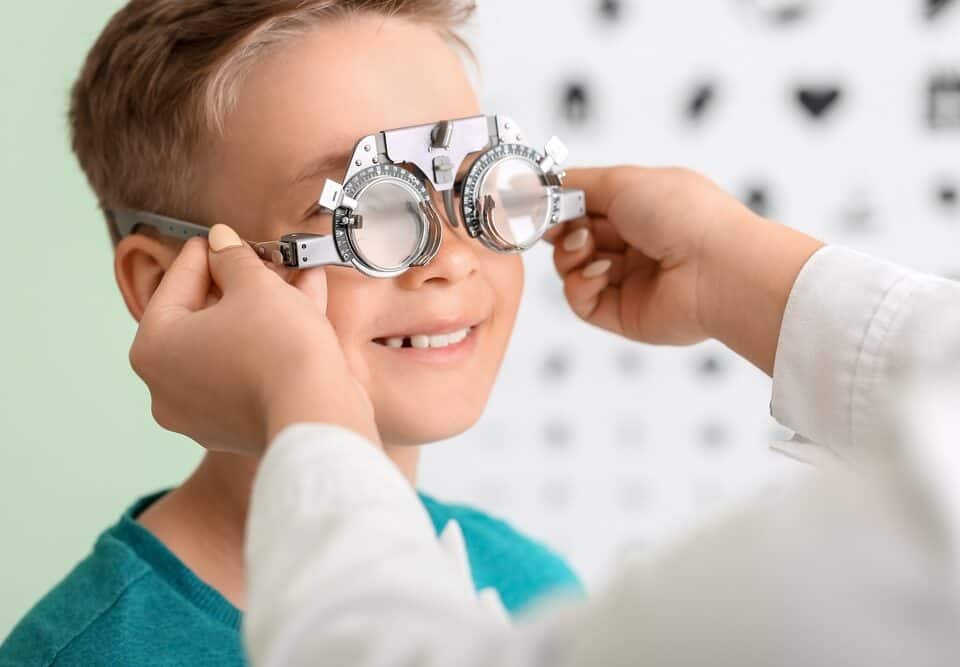
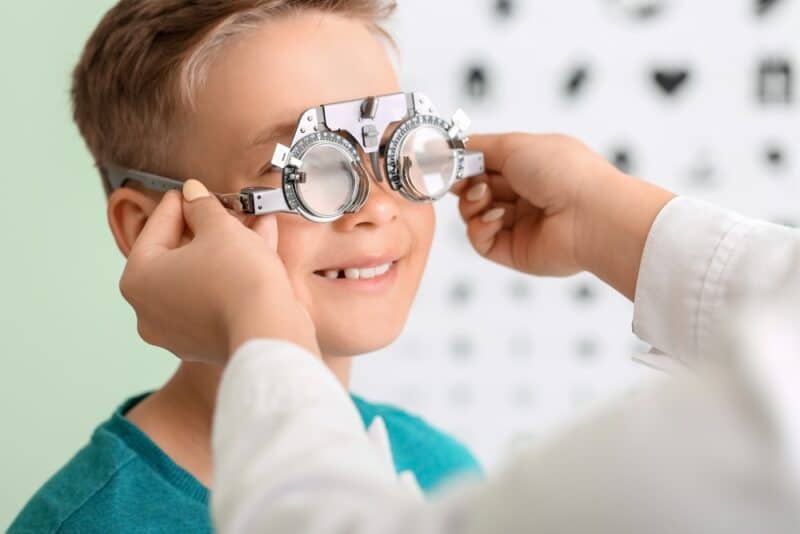
A comprehensive pediatric eye exam differs significantly from adult eye exams. We use specialized techniques and equipment designed for children’s developmental stages and attention spans.
The exam includes testing visual acuity, checking how well the eyes work together as a team, evaluating focusing abilities, assessing eye movement and tracking skills, testing depth perception and color vision, and examining overall eye health. For younger children, we use picture charts, symbols, or special techniques that don’t require reading.
Most pediatric eye exams take about an hour and are designed to be engaging rather than intimidating. The key is finding an optometrist experienced in working with children who can make the process comfortable and even fun.
Age-Specific Testing Methods for Different Stages
The approach to testing your child’s vision changes dramatically based on their age and developmental stage. Understanding what to expect can help you prepare your child and ensure a successful exam experience.
For infants (birth to 12 months), we check basic eye health, pupil responses to light, and whether your baby can fixate on and follow objects. We look for proper eye alignment and check for conditions like blocked tear ducts or congenital cataracts. The ability to fixate on an object usually develops within the first month, while following moving objects typically develops by three months.
Toddlers and preschoolers (1–4 years) receive more interactive testing. We use LEA symbols—pictures of apples, houses, squares, and circles—instead of letters. We might use special tests with black and white striped patterns that naturally attract children’s attention. These tests can detect vision problems even in children too young or shy to respond verbally.
School-age children (5+ years) can typically participate in more traditional eye chart testing, though we still make the experience engaging. We can test for reading-related vision skills, including how well the eyes track across text, focus on near objects like books, and work together during close-up tasks.
Throughout all ages, the examination includes checking eye health using specialized lights and instruments. For some conditions, eye drops might be used to dilate the pupils, allowing a complete view of the internal eye structures. This process is painless but may cause temporary light sensitivity.
The key difference in pediatric eye care is our ability to adapt testing methods to each child’s personality, attention span, and developmental level. We’re trained to recognize when a child is getting tired or overwhelmed and can adjust the exam accordingly.
Common Vision Problems Found in NYC Children
In NYC’s diverse population, we see a range of vision problems that can significantly impact children’s daily lives and academic performance. Understanding these common conditions helps parents recognize when professional evaluation is needed.
Refractive errors—including nearsightedness (myopia), farsightedness (hyperopia), and astigmatism—affect at least 20% of children. Nearsightedness is becoming increasingly common, especially in urban environments like NYC where children spend more time on close-up tasks and less time outdoors. These conditions are easily corrected with properly fitted glasses.
Amblyopia, commonly called lazy eye, affects 1–3% of young children and can lead to permanent vision loss if not detected early. It occurs when one eye has decreased vision, often because the brain favors the stronger eye. Early treatment, sometimes as simple as patching the stronger eye, can be highly effective.
Strabismus, or eye misalignment, affects how well the eyes work together. Children might have eyes that cross inward, drift outward, or don’t align properly. This condition can cause double vision, poor depth perception, and difficulty with reading and sports. Treatment might include glasses, vision therapy, or in some cases, surgery.
Convergence insufficiency affects the eyes’ ability to work together during close-up tasks like reading. Children might experience eye strain, headaches, difficulty concentrating, or words appearing to move on the page. This condition is often missed in basic screenings but significantly impacts academic performance.
Color vision deficiencies, while not affecting academic performance directly, can impact a child’s ability to use color-coded learning materials or participate fully in certain activities. Early detection helps teachers and parents provide appropriate accommodations.
The encouraging news is that most childhood vision problems are treatable when caught early. The earlier the detection and treatment, the better the outcomes for your child’s vision development, academic success, and overall quality of life.
Protecting Your Child’s Vision and Academic Future
Your child’s vision directly impacts their ability to learn, play, and thrive in school and life. In NYC, where academic expectations are high and competition is fierce, ensuring your child has the visual tools they need for success isn’t just important—it’s essential.
Remember that 25% of all children have vision problems significant enough to affect school performance, yet many of these issues go undetected until academic struggles become obvious. By following recommended exam schedules and choosing experienced pediatric eye care providers, you’re giving your child the best foundation for healthy vision development.
Don’t wait for problems to become apparent. Early detection and treatment of vision issues can prevent years of academic frustration and help your child reach their full potential. When you’re ready to schedule your child’s comprehensive eye exam, we offer the specialized pediatric eye care and kid-friendly environment your family deserves.